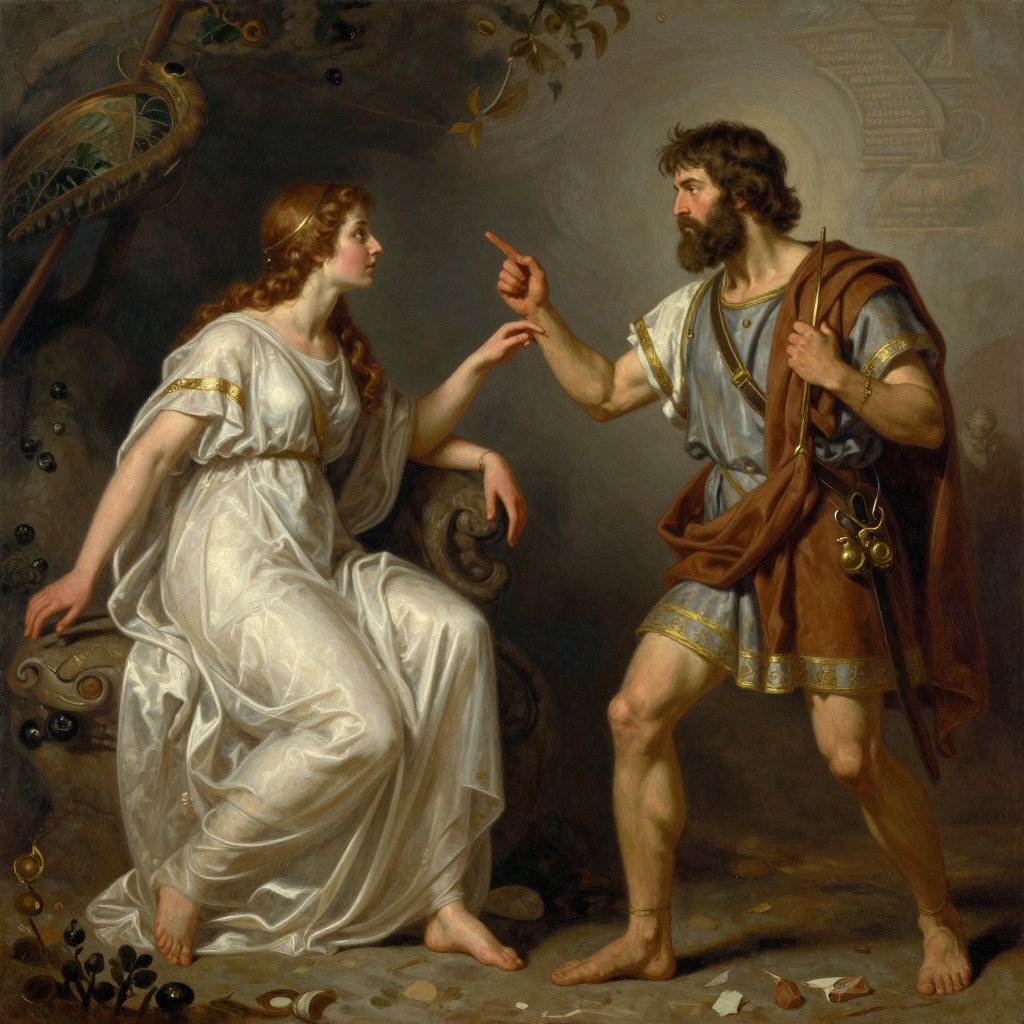
Aegisthus
Aegisthus, son of Thyestes, is the central figure of a cautionary narrative that runs through the Odyssey as the archetype of adulterous usurpation and its inevitable punishment. His story—the seduction of Clytemnestra, the murder of Agamemnon, and his own death at the hands of Orestes—is invoked repeatedly by gods and mortals alike to frame the moral and theological stakes of the poem. Zeus himself opens the divine council by holding up Aegisthus as proof that mortals bring suffering upon themselves through their own folly, since he ignored the explicit warning sent by Hermes. This paradigmatic tale establishes the pattern against which Odysseus's own homecoming and the fate of the suitors are measured.
Background and Crime
Aegisthus was the son of Thyestes, and his lineage was already marked by a curse. While Agamemnon was fighting at Troy, Aegisthus remained in Argos, where he began to court Clytemnestra. At first she resisted his advances, being of a good natural disposition, and Agamemnon had left a bard to guard her. But Aegisthus carried the bard off to a desert island and left him for birds to devour, after which Clytemnestra went willingly to his house. He then offered many burnt sacrifices to the gods and decorated temples with tapestries and gilding, having succeeded far beyond his expectations. For seven years after killing Agamemnon, Aegisthus ruled in Mycenae, and the people were obedient under him.
The Murder of Agamemnon
When Agamemnon returned from Troy, Aegisthus had set a watchman to look out for him, promising him two talents of gold. The watchman had been watching for a whole year. When Agamemnon landed, Aegisthus laid a plot: he picked twenty of his bravest warriors and placed them in ambush on one side of the cloister, while on the opposite side he prepared a banquet. He sent chariots and horsemen to invite Agamemnon to the feast, meaning foul play. Agamemnon came unsuspecting, and when the banquet was over, Aegisthus killed him as though he were butchering an ox in the shambles. Not one of Agamemnon's followers was left alive, nor any of Aegisthus's men; all were killed in the cloisters. The ghost of Agamemnon later describes the scene to Odysseus in the underworld: he lay dying with the sword in his body, and Clytemnestra would not even close his eyes or mouth.
Divine Warning and Human Responsibility
Zeus emphasizes that Aegisthus acted with full knowledge of the consequences. He sent Hermes to warn Aegisthus not to kill Agamemnon nor to woo his wife, because Orestes would take revenge when he grew up and wanted to return home. Hermes told him this in all good will, but Aegisthus would not listen. Zeus declares that Aegisthus now lies in a death that is his due, and Athena echoes that so should perish all who work such deeds. This divine warning establishes that Aegisthus's fate is not arbitrary but the result of his own deliberate choice to ignore clear prophecy.
Death and Aftermath
In the eighth year after the murder, Orestes came back from Athens and killed Aegisthus, the murderer of his father. He then celebrated the funeral rites of his mother and of false Aegisthus by a banquet to the people of Argos. On that very day Menelaus returned home with as much treasure as his ships could carry. The story of Orestes's vengeance is held up by Nestor to Telemachus as a model of filial duty: "See what a good thing it is for a man to leave a son behind him to do as Orestes did." In the underworld, the ghost of Agamemnon tells Odysseus that Aegisthus and his wicked wife were the death of him between them, and he warns Odysseus not to be too friendly even with his own wife, though he acknowledges that Penelope is an admirable woman.
Narrative and Thematic Significance
Aegisthus functions as the negative exemplar against which the entire moral architecture of the Odyssey is built. His story is told by Zeus in the first divine council, by Nestor to Telemachus, by Menelaus through Proteus's prophecy, and by Agamemnon's ghost in the underworld. Each retelling reinforces the same lesson: that the gods warn mortals, that mortals choose their own destruction, and that justice—whether through divine intervention or human vengeance—will eventually come. The parallel between Aegisthus and the suitors is deliberate: both usurp another man's wife and property, both ignore warnings, and both are killed in the house of the man they have wronged. But where Aegisthus's story ends in blood and lasting shame, Odysseus's story ends in restoration, precisely because Odysseus, unlike Aegisthus, heeds divine counsel and acts with cunning rather than reckless arrogance.